

Getting into law school is more competitive than it has been in years. In 2025, applicants jumped 18% to 76,500, the highest volume since 2011. And the volume of applicants just seems to keep growing – volume is up 9.1% already compared to the same point in November last year.
As always, and not surprisingly, the pressure is greatest at the top. Already, early data for the Fall 2026 entering class shows that median LSAT scores have risen by 1 point at nearly half of the top schools, and competition is stiff. It’s no secret that BigLaw and federal clerkship placement across T14 cohorts continues to range between 57-77%.
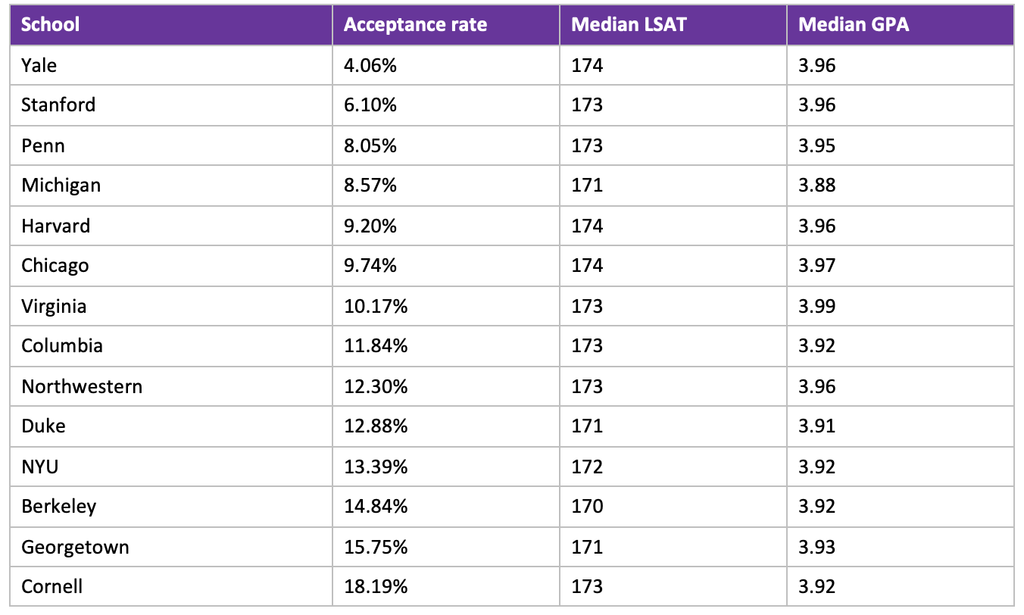
Although the average acceptance rate across all ABA-approved law schools in the United States was 36% for fall 2025, many of the top schools admitted fewer than 10% of applicants. Last year, Yale’s 4.06% rate was its lowest since at least 2016, and Stanford’s 6.10% was its lowest in five years. Here is a quick snapshot of the basic stats of T14 law schools for the class that entered in Fall 2025, based on each law school’s ABA 509 report:
How does U.S. News & World Report rank law schools?
With more applicants competing for seats, it is so important to understand how law schools think and what really matters.
The formula U.S. News is using now is relatively new. In late 2022 and 2023, dozens of top law schools (and more than 60 nationwide) boycotted the U.S. News rankings, arguing that the formula penalized public interest careers, discouraged need-based financial aid, and placed too much weight on test scores and subjective peer surveys.
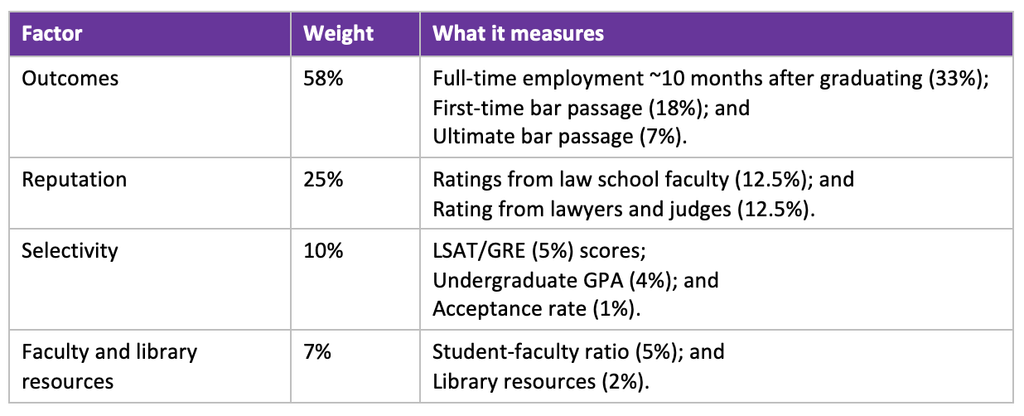
In response, U.S. News overhauled its methodology beginning with the 2023-24 cycle by eliminating student debt and per-student spending from their formula, reducing the weight of LSAT/GPA scores down to 10% (stay tuned, this sounds like students get a break, but they really don’t), and increasing the weight of employment outcomes and bar passage to 58% of the total ranking score while also giving full credit to school-funded public interest fellowships.
Here’s how all of that breaks down:
This change in ranking system marked the end of Yale’s #1 streak for as long as anyone can remember, with Stanford taking over the throne. It also allowed some new schools like Vanderbilt, UCLA, and WashU to break into the top 14 while UC Berkley and Georgetown fell in rank. Schools with aggressive career services and high bar passage rates jumped, with UVA climbing its way to the top 5.
So why does this all matter, you ask? And how can a school even predict a student’s outcomes?
Why do rankings shape law school admissions?
Think about it: when almost 60% of a law school’s ranking depends on whether its graduates get hired and pass the bar, admissions officers have to either turn into fortune tellers or rely on data when making admissions decisions.
Assuming they go the data route, the only hard numbers any law school really has on an applicant are their LSAT score and their undergraduate GPA. Even work experience is subjective depending on the employer, the amount of time worked, and the quality of a position held. The Law School Admission Council has a collection of LSAT Correlation Study reports that ultimately conclude that the strongest single predictor of first-year law student grades is the LSAT score, stronger even than the undergraduate GPA, and that the two combined are the best predictor of all. Here’s a snapshot of LSAC’s reported correlations, adjusted to account for the fact that law schools only see grades for students who are admitted:
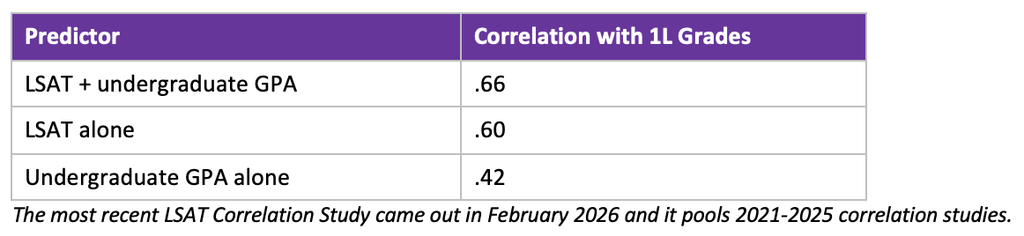
Now, I’m not great at math, so for those of you out there like me who get confused the minute a decimal appears, in plain English, the takeaway of these results is that if you take two admitted law school students at random, studies show that the one with the stronger LSAT and undergraduate GPA will earn better first-year grades roughly seven times out of ten.
Remember, large law firms do much of their hiring based on 1L grades and class rank, and these grades are the strongest predictor of bar passage (although not necessarily the strongest predictor of career success). In an AccessLex study of nearly 5,000 graduates from 20 law schools, law school GPA was the strongest predictor of bar exam performance, even early in law school. This is why the numbers start to matter so much in law school admissions.
How is grade inflation affecting the value of the undergraduate GPA?
Probably the worst thing that could have happened to students in recent years is grade inflation. How can an undergraduate GPA mean anything when everyone gets an A? The average number of grades at top universities has increased by 10-20% over the past ten years. The result is what LSAC has coined a “ceiling effect” – so many applicants have near-top GPAs that GPA has become a weak predictor, while the LSAT remains a strong one.
Should I work before applying to law school?
In the past few years, we have seen a trend that law schools are preferring candidates that have some substantive work experience under their belts. At Harvard Law School, 82% of a recent incoming class was at least one year out of college, and 63% were two or more years out. That is a sharp change from 2005 to 2009, when 39% to 45% of each Harvard class came straight from college.
Does this mean everyone should take a year or two off in between college and applying to law school? No, not necessarily, but the trend tracks law school’s desire to predict student success and, other than the LSAT, work experience can be the next best predictor since the undergraduate GPA has lost its value.
Their logic is simple. If more than half of a school’s ranking depends on employment and bar passage, an applicant who has already shown an employer they can do the job offers a strong signal that they will be employable after law school too. Students coming straight from college with strong numbers still remain competitive, but in their case, their numbers will ultimately drive the opportunities that will present themselves.
What if your LSAT score stinks and your GPA is just ok?
If your LSAT and GPA fall on the lower end of a school’s range, and a student is applying to law school straight out of law school, then their personal statement and recommendation letters have to do some heavy lifting.
How do you get strong letters of recommendation?
Most law schools ask for two to three letters, and ideally two should come from professors who know a student’s academic work well. If a student is applying to law school directly out of college, these letters carry extra weight – they’re one of the few ways a law school can learn about how a student thinks and works beyond their numbers.
With college applications a distant memory, college students often forget the importance of forging real relationships with their instructors. But for those who want to apply to law school out of college, getting a good recommendation letter is key. Simple advice: take some time to get to know your professors and make sure they get to know you as a student and an academic.
How do you write the personal statement? Is it like writing the Common App personal essay?
Writing the law school personal statement is not like writing the Common App personal essay. It requires a different tone, more reflection, and it has to “make your case” for why you would make a good law student (without really saying that, of course).
This year, for whatever reason, the law school personal statements we have been reading are – literally – all over the place. We’ve been seeing a lot of AI slop, and clearly Claude hasn’t mastered this skill yet. These are the main problems we’re seeing come up again and again:
- No focused theme. We’re seeing essays that jump between experiences without a single idea tying them together. While that may work for certain types of writing, it definitely won’t do the trick when applying to law school. The law school personal statement needs to be focused – you need to present a coherent thought process.
- Resume Dumps. Students drop in accomplishments that do not connect to the story they are telling. It’s better to pick one thing to talk about, explore it well, and have it make sense rather than try to throw everything and the kitchen sink off your resume into your law school personal statement.
- The student is not the main character. The essay centers on a parent, a mentor, or a client, and there is no room for real reflection about who the applicant is. Law schools don’t want to know about the person that inspired you, they want to know about you, the way you think, and what you hope to do in the future.
- No credible connection to law. The essay doesn’t convey a clear message about why the student wants to apply to law school and be a lawyer. Although the personal statement doesn’t need to spend too much real estate on this, there should be some point toward the end of the essay that addresses this.
Law school admissions officers read a ton of applications, just like undergraduate admissions officers. So, imagine that they need to get through your application in about ten minutes. That means your information and your story need to come across clearly. Your personal statement has to be clear, concise, and an easy read. A focused essay with one theme, genuine reflection, and a credible reason for pursuing law will stand out. A scattered one will not.
How can Opus help?
At Opus College Prep, I help law school applicants build a clear strategy, from LSAT planning to a personal statement that reads well in the few minutes it gets. If you are preparing to apply, reach out to schedule a consultation.