

Application Tips, PIQ Strategy & What to Expect.
Thinking about the University of California? You’re in good company. From Berkeley and UCLA to San Diego, Santa Barbara, and beyond, the nine UC campuses offer world-class academics, California sunshine, and nine very different college experiences.
The good news: you can apply to all of them with just one application. In this guide, we’ll walk you through how selective each campus is, what UC readers look for, how to complete the UC application step by step, and the Personal Insight Question (PIQ) strategies our Opus counselors use to help students stand out. Let’s get you ready to apply.
How hard is it to get into the UCs?
It depends a lot on the campus. Systemwide, UCs admitted about 75% of first-year applicants for fall 2026, but selectivity ranges from about 1 in 10 at Berkeley and UCLA to nearly everyone at Merced.
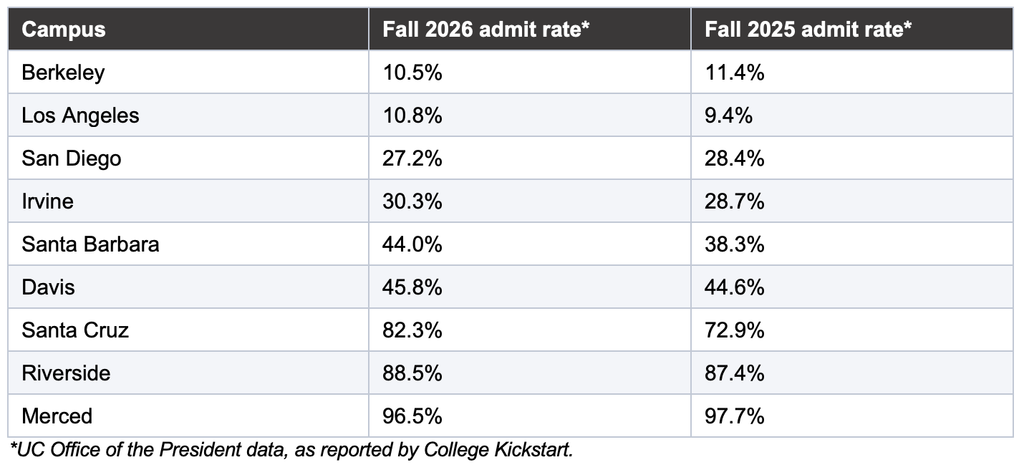
A few things to keep in mind:
- Berkeley is now the most selective UC, edging out UCLA for fall 2026.
- Admit rates vary by major. Engineering, computer science, and nursing are often far more competitive than a campus’s overall rate.
- Test scores don’t count. UC is test-free, so SAT and ACT scores play no role in admission.
- Build a balanced list. Because the same application goes to every campus, it’s easy to add a mix of reach, target, and likely UCs. Use these numbers as a guide to selectivity, not a prediction of your own chances.
What do the UCs look for?
First, you need to meet UC’s minimum requirements: 15 year-long A–G college-prep courses, with at least a 3.0 GPA in those courses for California residents (3.4 for nonresidents). Meeting the minimum makes you eligible, but at the more selective campuses, admitted students’ GPAs run much higher.
From there, every campus uses comprehensive review, based on 13 factors set by UC faculty. Each campus reviews your application independently, and the weight given to each factor can differ from campus to campus and year to year, but generally falls into a few broad groups:
- Your academic record. GPA in A–G courses, the rigor of your classes (honors, AP, IB, dual enrollment) and your senior-year course load, judged against what your school offers.
- Achievements outside the classroom. Leadership, activities, jobs, family responsibilities, the arts, athletics, and community service.
- Special talents and projects. Academic enrichment programs, research, or a talent you’ve developed in depth.
- Context. The opportunities available to you, how you used them, and challenges you’ve faced along the way.
- Your PIQs. These four short answers are where your experiences can come to life, in your own voice.
Does your major matter? Often, yes. Many campuses admit by major, and impacted majors like computer science, engineering, and nursing are far more competitive. Some arts, music, theater, and nursing programs also require a supplemental application, portfolio, or audition. At UCLA, for example, the Music, Arts and Architecture, Nursing, and Theater, Film and Television schools all require one, with deadlines from early December to late January. Check each campus’s website for your intended major.
Opus take: the strongest applicants have a “spike,” a clear area of depth and passion that runs through their courses, activities, and PIQs. You don’t need to do everything. You need to show what you care about and what you’ve done with it.
Application basics: How Do I Apply to the UCs?
The UCs don’t use the Common App, and there’s no Early Decision or Early Action at any campus. Everyone applies through the UC application, when then goes to every campus you select (with a fee for each). For fall 2027, the submission window runs October 1 to November 30, 2026.
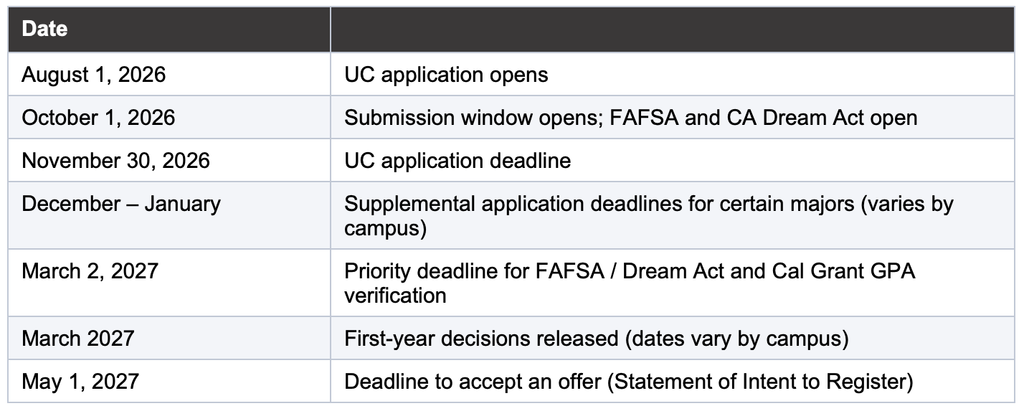
How long does it take? Longer than most students expect. Entering every course and grade from your transcript and writing up to 20 activity descriptions can take several hours on their own, and that’s before your four PIQs, which deserve weeks of drafting and revising. Our advice: open your account early, fill in the factual sections in a few sittings, and leave plenty of time for your PIQs. Don’t save it all for Thanksgiving weekend.
Completing the UC Application, Step by Step…
- About You. Enter your legal name exactly as it appears on your transcript, plus contact and residency details.
- Campuses & Majors. Choose your campuses and a major for each. Selecting more campuses won’t hurt your chances at any of them.
- Academic History. Self-report every A–G course and grade from 9th grade on, straight from your transcript, including repeated courses and low grades, plus your planned senior-year courses. Grades are verified if you enroll – a mismatch can put an offer at risk.
- Test Scores. Optional. SAT and ACT scores aren’t used for admission, but you can report AP/IB scores.
- Activities & Awards. Up to 20 entries, 350 characters each. Write for a reader who has never heard of your activity and include jobs and family responsibilities.
- Scholarships & Programs. Optional. Check the categories that apply to you.
- Personal Insight Questions. Answer four of eight (see below).
- Additional Comments. Optional. Use it only for context the rest of the application can’t show, such as an unusual grading scale or a tough semester. It’s not a fifth essay.
- Review & Submit. Save a PDF, check it line by line against your transcript, and submit a few days early.
Personal Insight Questions: Your Chance to Shine.
The PIQs are the heart of your UC application. You have to answer 4 of 8 questions, up to 350 words each, and all eight carry equal weight. UC calls them short answers, not essays: think of them as a conversation with your reader.
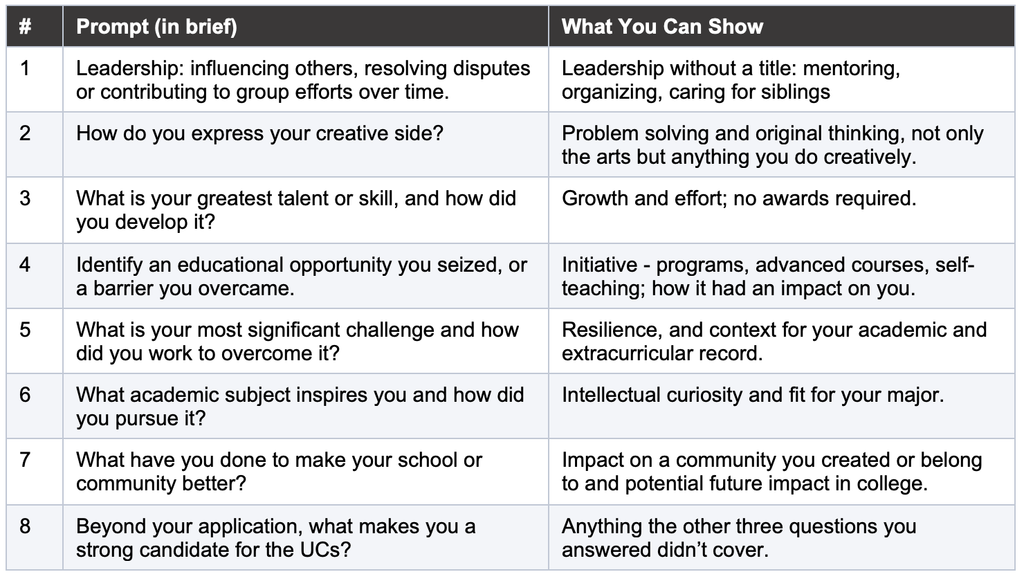
How do you choose your PIQs?
- Start with what you want UC readers to know about you, then pick the prompts that work best to tell your story. List the four or five things a reader should learn about you, then match each to the prompt where it fits best.
- Think of the four PIQs as a set. Each answer should reveal something new. No repeats.
- Show your academic side. At least one response (often #6, #4 or #3) should show how you think and learn, especially for engineering or another competitive major.
- Use #8 strategically for a story that doesn’t fit anywhere else, not to summarize your other answers.
- Only choose #5 if it’s real. As UCLA’s admissions office puts it: don’t manufacture hardship. Challenges matter when you show how they shaped who you are now.
Should you put your supplemental essays to work?
Before you start drafting, take inventory of the supplemental essays you’ve already written (or plan to write) for other colleges. A “why this major” essay often maps neatly onto PIQ #6, a community essay onto #7, and an “overcoming a challenge” or “tell us about an activity” essay onto #5, #1 or #3. Strategically matching what you have to the PIQs saves time and keeps your story consistent across applications.
One caution: don’t just paste them in. UC readers want a direct answer to their question, so rework each piece to answer the PIQ prompt in the first two sentences, cut anything school-specific, and make sure your answer fits within 350 words.
What are best practices for writing the PIQs?
- Answer the question/prompt clearly in your first two sentences. You don’t need to worry about a clever hook required – a good answer to the question is more important.
- Make yourself the focus. Write about yourself in the first person.
- Be specific. “Tutored 14 ninth graders every Tuesday” beats “I’m very dedicated.”
- Reflect more than you narrate. Spend about a third of your words on what happened and two thirds on why it mattered and how it changed you.
- Stay in the present. Focus on high school; don’t lose valuable real estate on childhood memories – those should lead quickly to who you are now.
- Use all the permitted space. Aim for 300–350 words per answer.
- Make it an easy read. Short paragraphs and clear topic sentences help a busy reader catch your main points.
What are common mistakes to avoid?
- Repeating your activities list in sentence form.
- Writing a formal five-paragraph essay that wastes words on a thesis and conclusion.
- Guessing what UC “wants to hear” instead of telling your own story.
- Letting a parent, counselor or AI write it for you. Feedback is fine, but the words must be yours, and plagiarism or false information can cost you an admission offer.
What should be your five-step game plan for applying to UCs?
- Take challenging courses and earn strong grades. Use the honors, AP and IB options your school offers, and keep your senior-year schedule rigorous.
- Find and develop your spike. Go deep in one or two areas you genuinely care about, and look for ways to grow your role over time.
- Write authentic PIQs. Choose four prompts that, together, show who you are, and fill them with specific details and real reflection.
- Make an impact in your community. Leadership can mean a title, but it can also mean mentoring, organizing or helping your family. All of it counts.
- Be yourself. UCLA alone reads about 147,000 applications. The ones that stand out sound like a real person, not like what an applicant is “supposed” to say.
What if you’re waitlisted?
Take a breath. A waitlist offer means a campus saw something it liked. Each UC runs its own waitlist, so if you want to stay in the running, opt in through that campus’s applicant portal by its deadline (UCLA’s is April 15). Many campuses, including UCLA, don’t accept extra materials such as recommendation letters from waitlisted students, so check each campus’s instructions before sending anything. In the meantime, commit to another school by May 1 so you have a home either way.
What do you know about the nine campuses?
One application, nine very different experiences. Before you choose your campuses, think about size, setting, academic strengths and the vibe you want for four years.
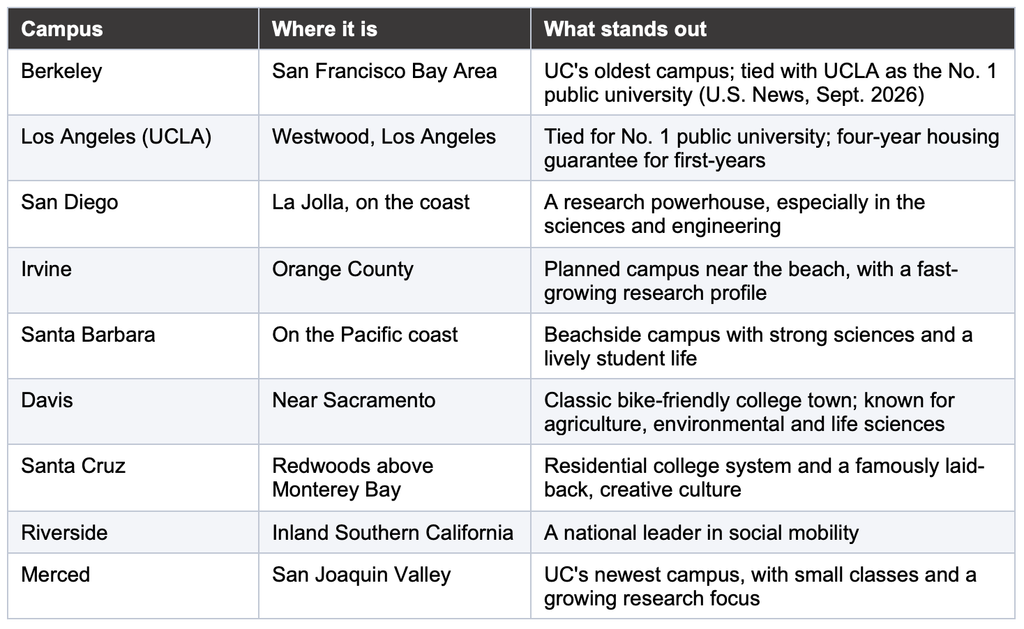
Opus tip: Visit if you can or take virtual tours. And don’t overlook the campuses with higher admit rates. Many students find their best fit, and real scholarship and honors opportunities, at a campus they didn’t first consider.
What’s the bottom line?
An admit rate is just a number, and it doesn’t tell your story. Take challenging classes, go deep in what you love, build a balanced list of campuses, and use your four PIQs to show UC readers exactly who you are. Start early, and you’ll give yourself a real shot at the UC that’s right for you.
Want expert help with your UC application?
At Opus College Prep, our counselors help students build a standout UC application, from choosing the right campuses and four PIQs to polishing every activity description. With the November 30 deadline coming up fast, now is the time to reach out. Let’s meet!